Skip to main content
HUMAN EAR
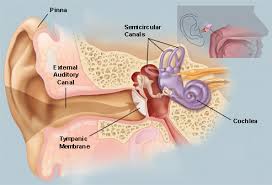 The human ear is divided into three structural parts: the outer ear,
the middle ear, and the inner ear. Also, each section has unique and
interconnected functions.
The outer ear collects sound waves that are then transferred to the
middle ear by vibrating against the ear drum (tympanic membrane). Sound
waves are converted into a mechanical vibration by the bones in the
middle ear. In the inner, specialized hair cells detect these
mechanical vibrations, then trigger a nerve impulse that is sent to the
auditory (hearing) part of our brain.
The outer ear determines the origin of the sound. Then it acts as a
filter to clean out the background noises to focus on the main sound
it’s looking for. Lastly, the outer ear acts as a funnel to increase
sound pressure along the ear canal. When the sound waves hit the ear
drum, it vibrates.
The middle ear works like a drumstick on a drum. The vibrating ear drum
of the outer ear is the drummer's arm, moving up and down. Attached to
this arm are the ossicles which, like a drumstick, pound on the oval
window of the inner ear. Sound vibrations enter the inner ear through
the oval window. Vibrations traveling through air in the middle ear
must be transferred efficiently through the oval window into the liquid
environment of the inner ear. The ossicle bones pounding on the oval
window complete this transformation. Without this mechanical step, the
amplitude of the sound waves would be dissipated as they pass from air
(which is highly compressible) to fluid (which is not very
compressible). The mechanical actions of the malleus, incus, and stapes
in the middle ear amplify the vibrations of the ear drum to efficiently
translate them to the oval window of the inner ear.
The inner ear is very complicated with many parts to it.
The human ear is divided into three structural parts: the outer ear,
the middle ear, and the inner ear. Also, each section has unique and
interconnected functions.
The outer ear collects sound waves that are then transferred to the
middle ear by vibrating against the ear drum (tympanic membrane). Sound
waves are converted into a mechanical vibration by the bones in the
middle ear. In the inner, specialized hair cells detect these
mechanical vibrations, then trigger a nerve impulse that is sent to the
auditory (hearing) part of our brain.
The outer ear determines the origin of the sound. Then it acts as a
filter to clean out the background noises to focus on the main sound
it’s looking for. Lastly, the outer ear acts as a funnel to increase
sound pressure along the ear canal. When the sound waves hit the ear
drum, it vibrates.
The middle ear works like a drumstick on a drum. The vibrating ear drum
of the outer ear is the drummer's arm, moving up and down. Attached to
this arm are the ossicles which, like a drumstick, pound on the oval
window of the inner ear. Sound vibrations enter the inner ear through
the oval window. Vibrations traveling through air in the middle ear
must be transferred efficiently through the oval window into the liquid
environment of the inner ear. The ossicle bones pounding on the oval
window complete this transformation. Without this mechanical step, the
amplitude of the sound waves would be dissipated as they pass from air
(which is highly compressible) to fluid (which is not very
compressible). The mechanical actions of the malleus, incus, and stapes
in the middle ear amplify the vibrations of the ear drum to efficiently
translate them to the oval window of the inner ear.
The inner ear is very complicated with many parts to it.


Comments